VCG INSIGHTS · PRIMERS · NO. 1
By Bhavik Khatri, Founder & Managing Principal
Back-Leverage
How lenders finance the loans they make, built up one block at a time, and the structural differences between facilities that decide how each one behaves under stress.
Part I. The building blocks
Block 1. A loan is an asset
A commercial real estate loan is an asset on the lender’s balance sheet. It pays a coupon, returns principal at maturity, and can lose value if the borrower defaults or the property is worth less than the loan. Like any asset, it can be held outright with equity, or financed.
Block 2. Financing an asset raises the return on equity, and the risk
A lender that funds a loan entirely with its own capital earns the loan’s spread. A lender that borrows against the loan earns the loan’s spread on the full amount, pays a lower spread on the borrowed portion, and keeps the difference on a smaller equity base.
> Return on equity ≈ (loan spread − advance rate × financing spread) ÷ (1 − advance rate)
The advance rate is the share of the loan the financing provider funds. Its inverse, the haircut, is the share the lender funds with equity. Higher advance rates raise returns and also magnify losses. A 25% haircut means a 25% loss of value wipes out the equity in that loan.
Block 3. Seniority decides who loses first
In any back-leverage structure there are two layers. The financing provider is senior. The lender’s equity is junior and takes the first loss. The provider is therefore lending against a cushion, and against a pool of loans rather than a single property. That is why a bank can be comfortable financing a portfolio of transitional loans it would not hold outright.
Block 4. Financing can be taken back
The deepest difference between facilities is not price. It’s how, and how quickly, the financing provider can reduce its exposure. There are four ways:
- Revaluation: re-marking the collateral and demanding cash if its value falls.
- Eligibility: removing a loan from the financed pool when it breaches criteria.
- Maturity and renewal: declining to renew, or renewing on worse terms.
- Remedies: enforcing against the collateral or the sponsor after a default.
Every facility type is a different combination of these four levers. Once you know which levers a facility gives the provider, you know how it will behave in a downturn.
Block 5. Duration match
A bridge loan might run three years with extensions. If the financing behind it runs one year, the lender carries refinancing risk on its own financing. Facilities that match the life of the collateral are more stable. Facilities that don’t are cheaper or more flexible, but they transmit stress faster.
Block 6. The exit
Most short-term back-leverage is built to be temporary. Loans sit on a facility until they pay off, are sold, or are moved into a longer-term vehicle such as a CRE CLO. When the exit is open, short-term facilities turn over. When it closes, they fill up and the lender’s ability to make new loans shrinks.
Part II. The facility types
1. Repurchase facility (repo)
How it’s documented. The lender sells the loan to the provider and agrees to buy it back at a set price, plus a funding charge. Economically, it’s secured financing. Legally, it’s a sale and repurchase.
- Mark-to-market rights. This is the most important term in the document.
- Credit-mark facilities let the provider revalue a loan only after a credit event, such as a payment default or a material decline in property performance.
- Market-mark facilities also allow revaluation when market spreads widen, even if the loan is performing.
- In a broad sell-off, the two behave very differently.
- Margin thresholds and cure periods. Many facilities only trigger a margin call once a markdown exceeds a threshold, and give the lender days to post cash. Small differences here matter a great deal in practice.
- Recourse. Repo facilities often include a guarantee from the fund or its parent covering a portion of the obligations. Recourse levels vary widely and shape how far a problem in one loan can travel up to the parent.
- Bankruptcy treatment. Repurchase agreements on mortgage loans generally qualify for safe-harbor treatment under the U.S. Bankruptcy Code. A provider can usually liquidate collateral without being stayed if the lender files. That protection is part of why providers offer higher advance rates in repo form.
- Purchase price vs. market value. The amount advanced is set against the provider’s view of value, not necessarily the loan’s par amount. Disputes about value are where margin calls get negotiated.
- Cash management. Payments on pledged loans often flow through accounts controlled by the provider, with the lender’s share released after the provider is paid.
- Future funding. Bridge loans often have unfunded commitments for renovation or leasing. Facilities differ on whether, and at what advance rate, the provider funds those future advances.
Behavior under stress: fastest to transmit stress, through revaluation and margin calls, especially on market-mark terms.
2. Loan-on-loan / note-on-note financing
How it’s documented. A conventional secured loan from the provider to the lender, with the lender’s mortgage note pledged as collateral. There’s no sale.
- Revaluation. Typically narrower than repo, often limited to credit events or periodic tests.
- Consent and control rights. The provider often has approval rights over modifications, extensions, releases and enforcement on the underlying loan. A borrower negotiating a workout may effectively need two parties to agree.
- Bankruptcy treatment. It generally lacks repo’s safe harbor, which is one reason advance rates can be lower.
- Single-asset or portfolio. It can finance one large loan or a pool. Single-asset deals are negotiated loan by loan.
Behavior under stress: slower than repo. Stress shows up through consent friction and eligibility tests, not daily margin calls.
3. Warehouse credit facility (revolving, asset-based)
How it’s documented. A revolving credit line secured by a changing pool of loans, sized by a borrowing base. Advance rates are applied loan by loan.
- Borrowing base mechanics. Capacity equals eligible collateral times its advance rates. When a loan becomes ineligible, the borrowing base falls and the lender may have to repay.
- Concentration limits. These cap exposure by property type, market, sponsor and loan size. They can force a lender to stop originating in a segment before it chooses to.
- Cross-collateralization. Loans in the pool often secure the whole facility. A problem in one loan can reduce capacity across all of them.
Behavior under stress: moderate. Eligibility and concentration tests tighten capacity gradually rather than all at once.
4. Term (match-funded) financing
How it’s documented. A longer-dated facility, sometimes non-mark-to-market, sized to run with the underlying loans.
- No or limited revaluation. Stability is the product, and it’s paid for in pricing and lower advance rates.
- Asset-level release prices. These govern how much of the facility the lender repays when a loan pays off.
Behavior under stress: among the most stable bank structures.
5. CRE CLO
How it’s documented. The lender sells a pool of loans into a securitization funded by bond investors in rated tranches. The lender typically retains the most junior pieces. Bisnow has reported that mortgage REITs commonly keep 20% to 30% of a CLO on their own books.
- No mark-to-market. Financing is matched to the life of the collateral.
- Coverage tests. If collateral performance deteriorates, overcollateralization and interest-coverage tests can divert cash away from the retained junior pieces to pay down senior bonds.
- Managed vs. static. Managed CLOs allow loans to be replaced during a reinvestment period. Static CLOs don’t.
- Workout flexibility. Modification and substitution rules in the deal documents limit what the lender can do with a troubled loan inside the CLO.
Behavior under stress: most stable funding, but cash-flow diversion can hurt the lender’s returns.
6. Senior note sale (A-note)
How it’s documented. The lender splits a loan into a senior and a subordinate piece. It sells the senior note outright, typically to a bank or insurer, and keeps the subordinate note.
- True sale. There’s no recourse back to the lender, and the financing doesn’t sit on the lender’s balance sheet as debt.
- Intercreditor agreement. This governs control, cure rights and consent between the two note holders, and it becomes the key document in a workout.
Behavior under stress: no margin calls. Stress shows up as control and consent disputes between note holders.
Part III. Side-by-side
Part IV. Worked example: a margin call in a repo facility
The figures below are illustrative.
The borrower may still be current. The lender can post cash, sell the loan or negotiate the mark. Across a portfolio in a falling market, repeated calls like this are how a fund’s lending appetite can disappear quickly.
Part V. Why it matters beyond the lender
- Pricing. The cost and terms of back-leverage flow straight into what debt funds quote borrowers. See Themes No. 2.
- Workouts. A borrower’s lender may need its provider’s consent to modify or extend a loan.
- Capacity. Eligibility, concentration and exit conditions can shut off a lender’s new originations regardless of its own investors’ appetite.
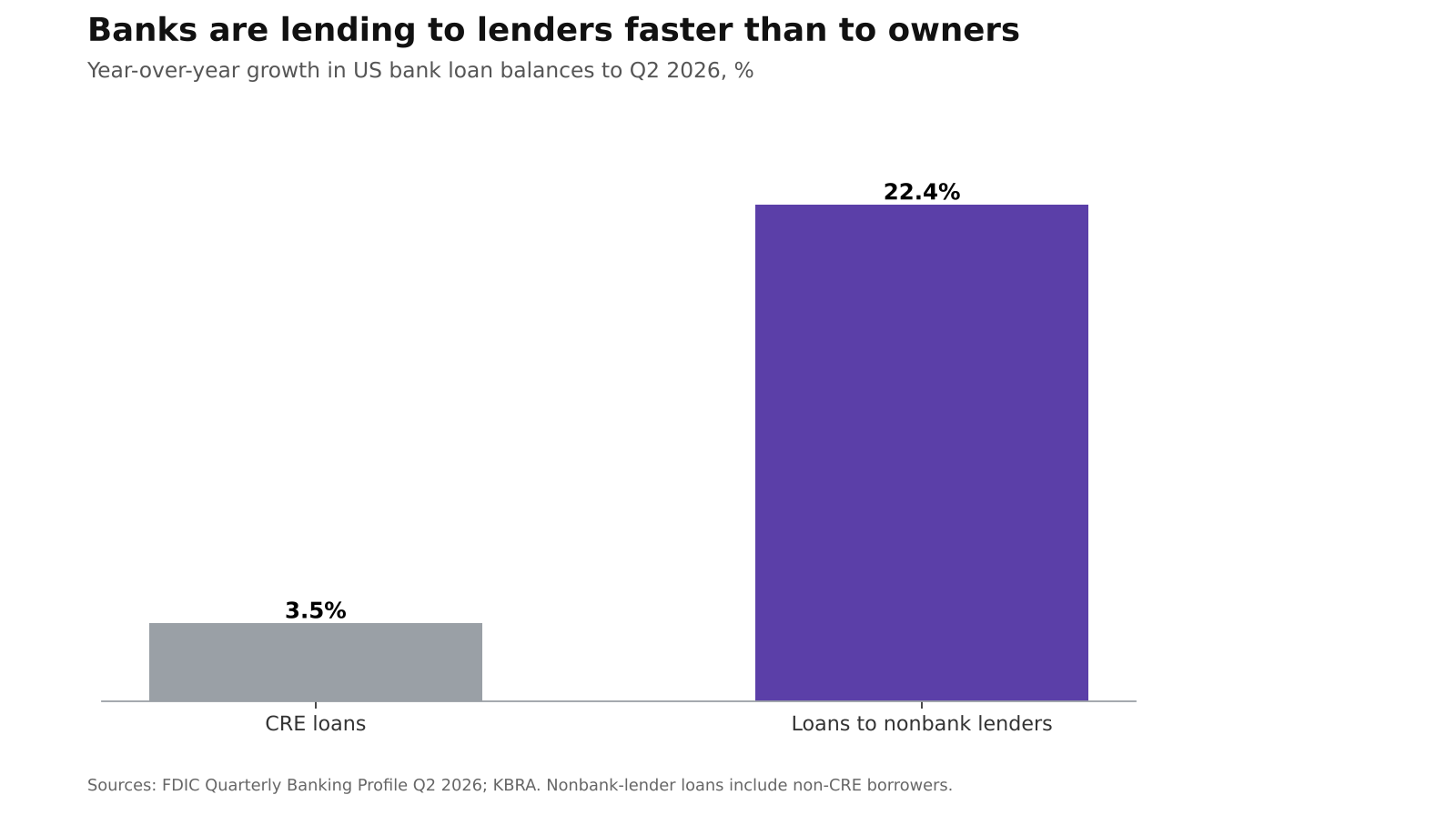
- Scale. FDIC data show bank loans to nondepository financial institutions rose 22.4%, or $279 billion, in the year to June 2026. That compares with 4.1% growth in bank loans on commercial property. The nonbank figure includes non-real estate borrowers.
!Banks are lending to lenders faster than to owners
See also
Sources and methodology
- Sourcing note: we cite the organization that produced each figure. Where its own release isn’t publicly accessible, we name the outlet we read it in.
- Bank lending: FDIC, Quarterly Banking Profile, Q2 2026 (Table II-A and narrative).
- Loans to nondepository financial institutions rose $279.1B (22.4%).
- Nonfarm nonresidential loans rose 4.1%.
- The nonbank category includes non-CRE borrowers.
- Warehouse financing and CRE CLOs: Moody’s Ratings, as reported by CRE Daily (2026). Subscription-only.
- CLO retention: Bisnow, “The Recession Killed This CRE Financing Tool, But It’s Back,” reporting that mortgage REITs tend to keep 20% to 30% of a CLO on their books.
- Facility terms: advance rates, mark-to-market provisions, margin thresholds, recourse, consent rights and bankruptcy treatment vary by document and jurisdiction. The descriptions here are general, not a survey of market terms or legal advice.
- Worked example: VCG assumptions, not market data. Margin requirement = amount advanced − (advance rate × revised loan value).